

Published: June 2026
A usage study based on a sample of 82 real Japan trips, with data measured from the network (2024–2026).
Most advice about "how much eSIM data you need for Japan" is guesswork: a writer's hunch, or a number copied from another blog that copied it from somewhere else. This study takes a different approach. Instead of asking travelers what they think they used, Travelsim Asia measured what they actually consumed, reading real network usage from 82 activated Japan eSIMs rather than relying on self-report.
The short version: most travelers in Japan use a little under 5 GB on a short city trip, and around 8 GB on a typical two-week visit. They tend to buy a bit more than they need, but it costs them almost nothing to do so, and the more common mistake is buying too little. Here's what the data shows.
Key findings
What the data shows
- Travelers in Japan use a median of about 4.7 GB per trip. Engaged users, those who lean on their eSIM as a primary connection, use around 7–8 GB.
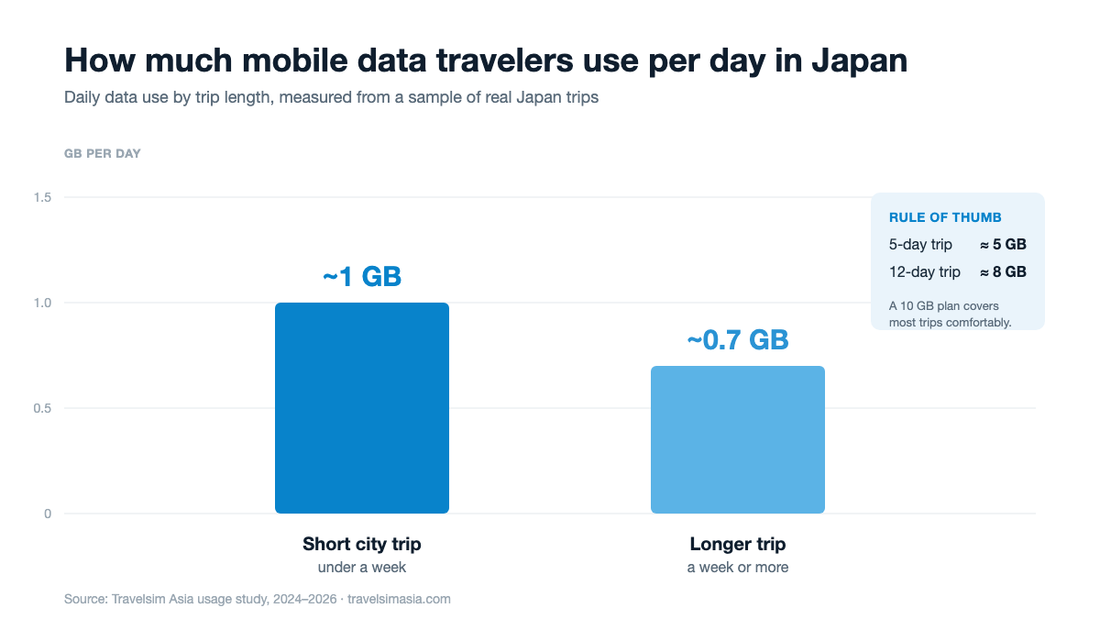
- About 1 GB per day is a safe planning figure for a short Japan trip. Longer trips settle closer to 0.7 GB per day, as heavy early-trip use gets diluted across quieter days.
- About 39% of all data bought for Japan trips goes unused, but it only costs travelers about 11% more than a perfectly sized plan. Because larger bundles are cheaper per gigabyte, overbuying is cheap insurance.
- Around 26% of Japan travelers run out of data or have to top up mid-trip. Running out is the costlier mistake: a top-up bought under pressure is rarely the better deal.
- 61% of travelers buy and activate their Japan eSIM on the same day, often on arrival. The old "buy weeks before you fly" advice no longer matches behavior.
- The median Japan trip runs about 12 days, splitting into two clusters: short city breaks of 4–6 days and longer "Golden Route" itineraries of around two weeks.
- Data use in Japan has held steady for three years. Median plan utilization was 76% in 2024, 73% in 2025, and 77% in 2026.
How much data travelers actually use
Across 59 completed Japan trips, the median traveler used 4.7 GB and the average 6.6 GB. Utilization, meaning how much of a purchased plan a traveler actually consumes, had a median of 76%.
That overall figure hides a split. A minority of travelers barely touch their data (more on them below), which pulls the average down. Looking only at engaged travelers, those who used their eSIM as a real connection rather than a dormant backup, the picture tightens considerably: a median of about 7.3 GB used at 81% utilization. Travelers who actually rely on their eSIM use most of what they buy.
The market has converged on a default purchase. Among real (activated) trips, the most common plans were the 20 GB option (about 35% of trips) and the 10 GB option (about 28%), with 5 GB third (17%). Plans of 3 GB or less remain a niche, together under a fifth of trips. The median plan bought is 10 GB, a sensible match for a typical trip.
The rule of thumb: how much per day
The most useful number for planning is data per day, because it lets any traveler size their own trip. Measured across Japan trips where the full duration was observed:
| Trip length | Typical use per day |
|---|---|
| Under a week | ~0.9–1.2 GB/day |
| One to two weeks | ~0.6–0.7 GB/day |
| More than two weeks | ~0.7–0.8 GB/day |
Short trips burn data noticeably faster per day. The likeliest reason is front-loading: maps, translation apps, and photo uploads are heaviest in the first days of a trip, and on a short itinerary that intensity never gets averaged out across quieter days.
A simple planning rule
Budget roughly 1 GB per day for a short Japan trip, and about 0.7 GB/day for a week or longer. A 5-day city break works out to around 5–6 GB. A typical 12-day trip is about 8 GB, i.e. a 10 GB plan. Two weeks or more lands at 10–15 GB.
These are guides, not guarantees. A traveler who hotspots a laptop or streams video will run well above them; someone who mostly uses hotel and café Wi-Fi will run below.
Buying versus using: most people slightly overbuy
Of all the data sold to completed Japan trips, about 39% went unused. That can sound wasteful, but the per-gigabyte economics change the story: because bigger bundles are cheaper per GB, a traveler who buys one size up from what they end up needing overpays by only about 11% versus a perfectly sized plan. For a category where running out mid-trip is a real cost, paying a few dollars for headroom is a rational choice, and the data suggests travelers make it deliberately rather than by accident.
The clearest example is the 10 GB plan. It is one of the most popular purchases, yet its buyers use the least of it proportionally: it works as the "safe default" for cautious travelers who would have been fine on 5 GB but rounded up. That is overbuying, but it is cheap overbuying.
Running out: the costlier mistake
The opposite error is more painful. Around 26% of Japan travelers either drained their plan to the last byte or had to top up mid-trip, and roughly 1 in 5 completed trips ran their plan down to 97% or more. Buyers of the smallest plans were the most exposed: the 1 GB and 5 GB options produced most of the run-outs.
One traveler on a 5 GB plan is a good illustration. Around a week into the trip they hit their limit and bought a 20 GB top-up, finishing at roughly 24 GB used, nearly five times the original plan. The pattern repeats across the data: travelers who run out once tend to top up big the second time. A top-up is bought under pressure, sometimes in a city with no connection to buy it on, and often at a worse effective per-GB rate than sizing up at purchase would have been. Run out once, never again.
The travelers who barely use their data
About 1 in 5 completed trips used less than 10% of their plan, and some used essentially nothing, despite having activated the eSIM in Japan. These are not abandoned purchases; the eSIM connected to a Japanese network. The most likely explanation is dual-SIM behavior: travelers who keep the eSIM as a standby line, lean on a separate primary SIM or pocket Wi-Fi, or fall back on accommodation Wi-Fi for most of their trip.
It points to a gap between data bought and data needed, with a meaningful slice of travelers treating a travel eSIM as insurance rather than as their main connection.
When people buy
eSIM buying has become a last-minute, on-the-move behavior. 61% of travelers activated within 24 hours of purchase, and 84% within three days. The median gap between buying and activating was under a day.
The practical implication is that the long-standing advice to "buy your eSIM weeks before your trip" no longer describes what travelers do. Purchase now happens on the plane, at the airport, or in the hotel on the first night. The one thing still worth doing in advance is installing the eSIM before departure, so that only the final activation step needs to happen on arrival.
Three years, one pattern
The most reassuring finding for anyone planning a trip is how little this behavior moves year to year. Median utilization on completed Japan trips was 76% in 2024, 73% in 2025, and 77% in 2026. How much data people use in Japan has stayed close to constant, which is what gives the planning figures above their staying power.
Methodology and sample
Data source. First-party usage data from Travelsim Asia, an Asia-focused travel eSIM provider. The data is read from actual network usage, not self-reported.
Time period. Japan eSIM trips from 2024 through mid-June 2026. Analysis current as of June 2026.
Sample. This study draws on a sample of 102 Japan eSIM trips, of which 82 were activated by a traveler in Japan. Usage statistics are computed on the 59 trips that had completed (plan expired or fully used) at the time of analysis, so consumption figures are final rather than mid-trip.
Definitions. "Activated" means the eSIM connected to a Japanese network, which requires being physically in Japan. "Utilization" is data used divided by data purchased. "Engaged" travelers are those who used at least 10% of their plan. Trip length is measured from activation to the point a traveler removed the eSIM profile.
What we excluded and why. The 20 eSIMs that were never activated (cancelled, refunded, or issued-but-unused orders) are excluded from all usage figures, because activation requires being in Japan and an un-activated unit therefore represents no actual travel. A small batch of revoked orders is likewise excluded.
Verification. Headline figures were recomputed independently from the raw per-unit records. Where averages and medians diverge, we report medians, so that a handful of heavy users do not distort the typical picture.
Limitations. This is a single provider's customer base of roughly a hundred trips: real and measured, but not a statistically powered survey of all Japan travelers, so the findings are best read as observed behavior rather than population truth. Trip-length figures rest on a smaller subset of around 20 trips and should be treated as indicative. This is a living dataset, and Travelsim Asia will refresh it as the sample grows.
Source: Travelsim Asia first-party usage data, 2024–2026.